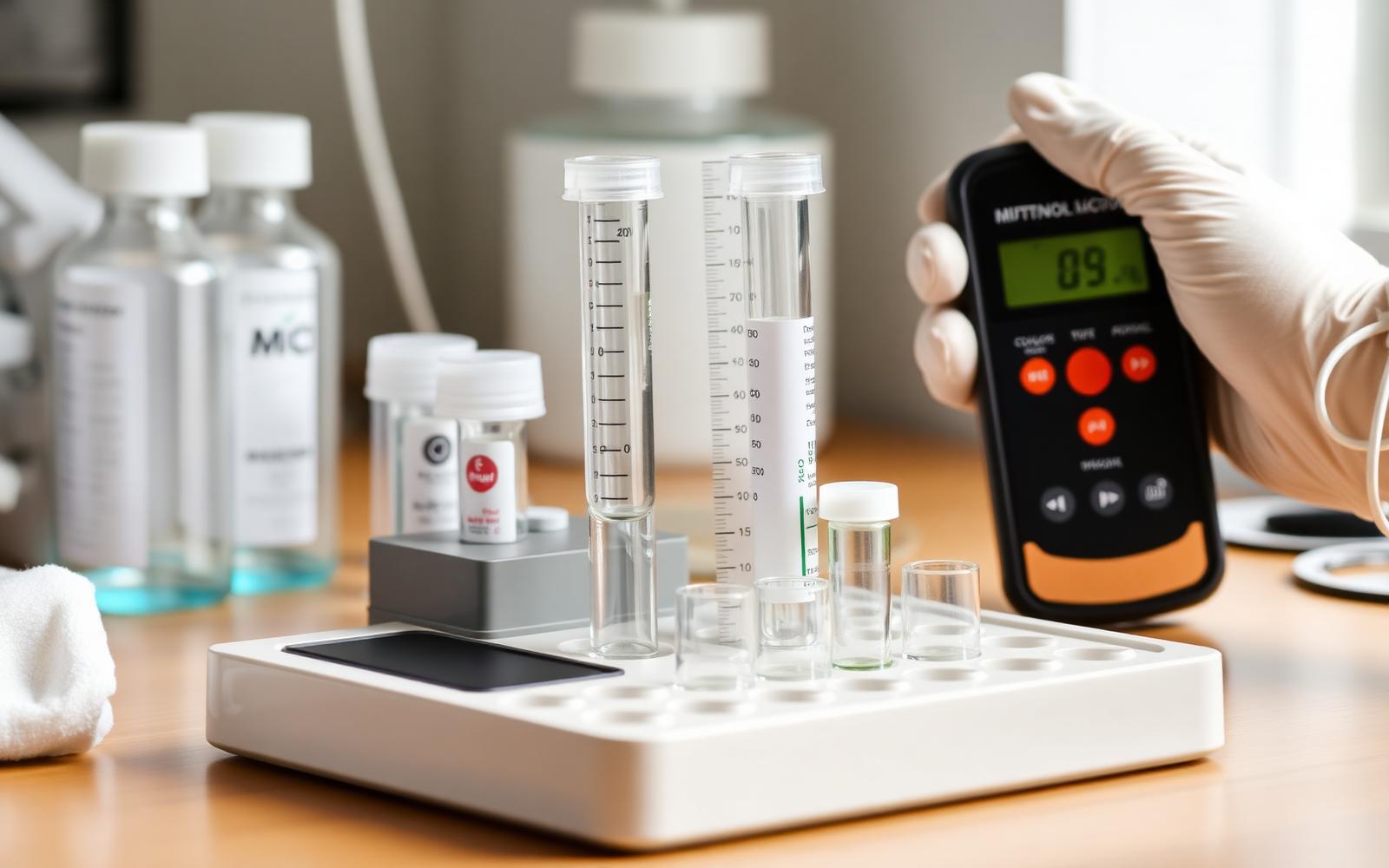
What an office air quality test measures
A professional office air quality testing programme covers the pollutants known to affect occupant health and productivity. Continuous monitoring captures carbon dioxide (CO₂), particulate matter (PM2.5 and PM10), total volatile organic compounds (TVOCs), temperature and relative humidity for at least two working weeks. Targeted laboratory samples extend the picture with speciated VOCs, formaldehyde and microbial indicators where the complaint pattern suggests they matter.
The combination matters more than any single reading. CO₂ on its own tells you about ventilation; PM2.5 on its own tells you about infiltration and filtration. Together with occupant survey data, they describe how an office actually performs across a working week — not just on the day an engineer happened to visit.
Our method — calibrated, accredited, repeatable
We use reference-grade or NDIR sensors calibrated against traceable standards for CO₂, particulates, temperature and humidity. VOC and formaldehyde samples are taken on sorbent tubes or passive badges and analysed by a UKAS-accredited laboratory using TD-GC-MS to the EN ISO 16000 series. Every monitoring location is geo-tagged and photographed; raw data is timestamped and retained for at least twelve months.
Testing covers a representative sample of zones — open-plan workspace, meeting rooms, executive offices, breakout areas and any zone with reported complaints. We deliberately include a control zone with no reported issues so the data has a baseline to compare against.
What you receive
Within five working days of the monitoring period we deliver a written report covering measured concentrations against BS EN 16798-1 Category I and II thresholds, WELL Building Standard Air Quality preconditions, CIBSE TM40 guidance and HSE EH40 limits where relevant. Heatmaps show how each pollutant tracked through the working week. Findings are explained in plain English so facilities, HR and senior leadership can act on them.
Every report ends with prioritised recommendations — what to fix first, what to monitor, what is already compliant. Where remediation is needed we provide indicative costs and the metrics we would expect to see after the fix.
When to commission an office air quality test
Office air quality testing is most commonly commissioned after occupant complaints, after a refurbishment or fit-out, before a lease renewal, as part of a WELL or BREEAM certification, or as a baseline for a continuous monitoring rollout. It is also worth running whenever a building changes use — for example, when a meeting-light office is repurposed for sales teams who fill rooms to capacity.
Hybrid working has made periodic testing more important, not less. Average occupancy is lower, but peaks on Tuesdays and Wednesdays often exceed pre-pandemic levels. Fixed ventilation schedules struggle to keep pace, and the data trail from a survey is what allows facilities teams to make the case for change.
Frequently asked questions
How long does an office air quality test take?
Continuous monitoring runs for two to four weeks to capture variation in occupancy, weather and operations. Targeted spot sampling for VOCs and formaldehyde takes around one working day on site. Reporting follows within five working days of data collection.
Do you need access outside working hours?
Sensors are installed during a single working visit and left in place. We do not need out-of-hours access unless your security policy requires it.
Is office air quality testing disruptive?
No. Equipment is compact, mains or battery powered and silent. Staff are usually only aware that monitoring is happening if they are told.
Which standards do you test against?
Reports benchmark against BS EN 16798-1, CIBSE TM40 and Guide A, WELL Building Standard v2 (Air concept), BREEAM Hea 02, WHO 2021 air-quality guidelines and HSE EH40 workplace exposure limits where relevant.