Why CO₂ is the most useful office air quality metric
Office CO₂ monitoring is the single most cost-effective intervention available to a facilities team. Indoor CO₂ above ambient is generated almost entirely by people breathing, and the rate at which it rises and falls is a direct proxy for how effectively outdoor air is being supplied to occupied zones. Two CO₂ sensors and a fortnight of data tell you more about a building's real ventilation performance than a year of complaint logs.
Above 1000 ppm, measurable declines in concentration and decision-making appear. Above 1500 ppm, occupant complaints multiply. The Harvard COGfx studies recorded an 11% improvement in cognitive scores when meeting-room CO₂ fell from 1400 to 600 ppm — an effect size large enough to matter to any knowledge-work organisation.
How we deploy office CO₂ monitoring
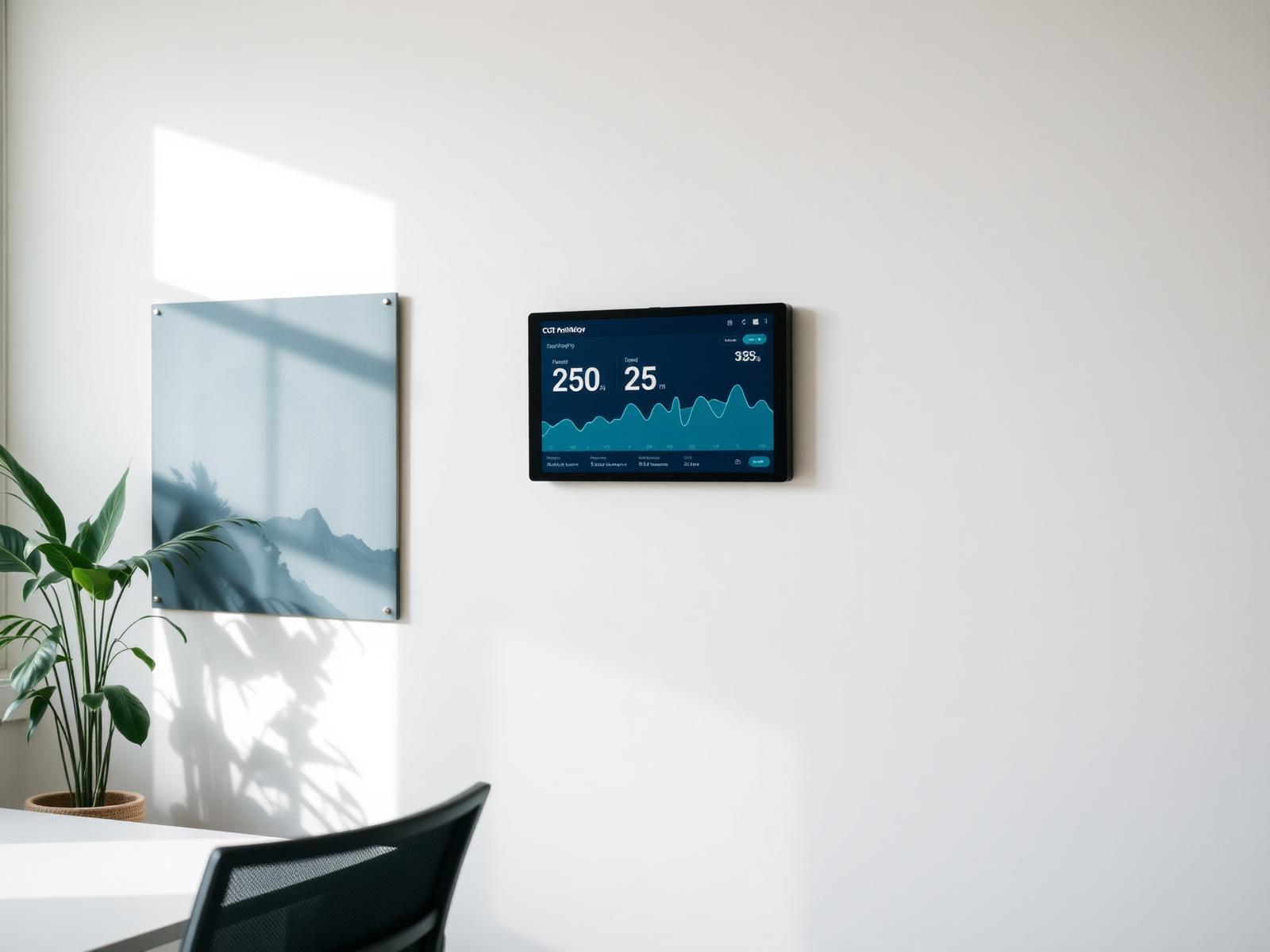
We use NDIR sensors with ±30 ppm accuracy, deployed at desk and breathing-zone height across a representative sample of open-plan workspace, meeting rooms and shared areas. Sensors are wireless, mains or battery powered, and stream data to a secure cloud dashboard. A typical office floor needs 6–12 sensor locations to characterise ventilation effectiveness reliably.
Where the AHU has built-in CO₂ control, we add reference sensors at the breathing zone to verify that the control signal matches what occupants actually experience — they often do not.
What the CO₂ data tells you
A healthy office shows CO₂ that stays below 1000 ppm during steady-state occupancy, with peaks in meeting rooms that fall away quickly when the room empties. The shape of the curve matters as much as the headline number — a slow morning rise that plateaus around lunchtime, then climbs again to a 4pm peak, is the classic signature of under-sized ventilation in a building running fixed-schedule supply against hybrid occupancy.
We benchmark every zone against BS EN 16798-1, CIBSE TM40 and WELL Air thresholds, then make a specific recommendation: rebalance, recommission, upgrade to demand-controlled ventilation, or hold and re-measure.
Continuous monitoring vs spot tests
One-off CO₂ spot tests have their place — typically as part of a wider office air quality survey — but continuous monitoring is now the operational norm. Twelve months of CO₂ data gives facilities teams the evidence to defend ventilation upgrades to finance, satisfies WELL Performance Verification, and provides the live dashboards tenants increasingly expect at lease renewal.
Frequently asked questions
What CO₂ level is acceptable in an office?
Steady-state CO₂ below 1000 ppm is the practical office target. Below 800 ppm is excellent. Above 1500 ppm sustained is a clear ventilation failure.
How many CO₂ sensors does my office need?
Around one sensor per 80–120 m² of open-plan workspace, plus one per enclosed meeting room. A typical 1,000 m² office floor uses 10–14 sensors.
Can you connect CO₂ monitoring to our BMS?
Yes. Sensors stream to our cloud dashboard by default, with Modbus, BACnet or API integration available where existing BMS or workplace platforms need the live data.